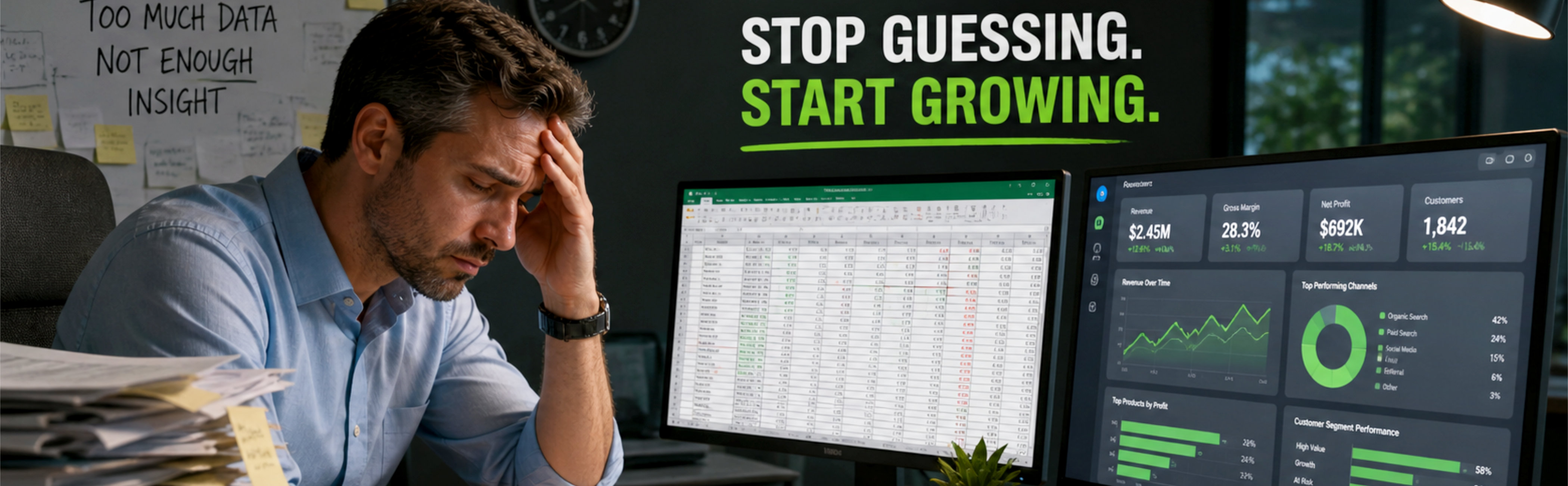
Is Your Data Working For You
Or Are You Working for Your Data
This takes about 4 minutes to read.
You’re successful. You’ve built something meaningful: your business is growing.
Yet, there is a nagging feeling that you’ve hit an invisible ceiling. You spend your days putting out fires and your evenings staring at messy spreadsheets. You know the answers to your most important questions remain hidden somewhere in your systems: how much profit you actually made last month, which marketing channel is truly working, or where your operational bottlenecks live.
The problem is that you cannot find them. Instead of using data to lead, you are drowning in it. This is often the primary driver of "Founder's Burnout": when you are working harder than ever, but your business feels like it is standing still.
The Spreadsheet Trap
Most SME leaders believe that more data equals more clarity. They invest in new software, buy expensive subscriptions, and collect endless lists of customer names and transaction dates.
They think they are building a foundation for growth. In reality, they’re just building a bigger pile of digital clutter.
If your data isn’t designed correctly from the start, it becomes noise. You end up spending hours trying to piece together a clear picture of your business: a process that is exhausting, error-prone, and incredibly expensive.
Why More Information Is Not the Answer
Having a mountain of information is not the same as having insight.
Think of it this way: imagine you want to build a beautiful, sturdy home. You go out and buy thousands of individual bricks, bags of cement, and lengths of timber. You pile them all in your driveway.
You have all the raw materials you need. However, you don’t have a house; you only have a massive, unorganised mess that is blocking your driveway and costing you money every day.
To build the home, you need a blueprint. You need to know how those bricks fit together to create a wall: and how those walls support a roof.
In business, "data design" is your blueprint. It is the deliberate process of deciding how information is captured, how it flows between departments, and how it turns into a decision.
The Cost of Leading in the Dark
When you lack a designed data structure, you’re forced to lead by "gut feeling." While intuition is valuable, relying on it exclusively is dangerous for your bottom line and stress levels.
The risks include:
- Wasted Marketing Spend: You keep pouring money into channels that look busy but do not actually drive profit.
- Operational Drag: You hire more staff to fix problems that a simple data insight could have prevented.
- Missed Opportunities: You fail to see a market trend until your competitors have already seized it.
- Expensive Errors: Small, undetected leaks in your margins can turn into six-figure losses over a single year.
The cost of staying the same is often higher than the cost of fixing the system.
From Chaos to Clarity: The Transformation
Imagine a different version of your work week.
Instead of wrestling with broken formulas, you open a single dashboard. You spot a 3% margin leak in a specific product line before it becomes a major issue. You see exactly which customer segment is driving your growth and which one is merely draining your resources.
You stop reacting to the past and start predicting the future. This is the shift from being an operator who is stuck in the weeds to being a leader who sees the whole landscape.
When your data is designed correctly, it becomes the engine for our "Captivate, Connect, Convert" methodology:
- Captivate: Use precise market data to find exactly where your next big customers are hiding.
- Connect: Understand customer behaviour so deeply that your communication feels personal and effortless.
- Convert: Turn leads into loyal advocates by making decisions based on facts rather than guesswork.
How DVANA Builds Your Blueprint
At DVANA, we do not just hand you more numbers. We help you build the blueprint.
We look at your sales, your marketing, and your operations to design a data ecosystem that actually serves your goals. We bridge the gap between the "noise" of modern technology and the practical reality of running a growing business.
Our goal is to take the complexity off your plate so you can focus on what you do best: growing your business. We help you move from the chaos of raw information to the precision of actionable insight.
Stop Guessing. Start Growing.
Do not let poor data design be the reason you hit your ceiling. It is time to turn your digital clutter into a roadmap for domination.
Get in touch to book a free review call today and let us help you build the foundation your growth deserves..